 All artificial tanks, i.e. requiring DNA sealing, They may have edges made of prefabricated concrete, or edges, them can be different types of walls or walls. The construction of the strengthening of the shore in the artificial tanks should be a gap, and enable the connection with the sealing material of the bottom. Therefore, the vertical walls of the tanks should be extended on 10-20 cm foundation foot to facilitate the connection with such material.
The walls of the tanks can be made as walls of different cross -sections, from natural or artificial stones connected by cement mortar. Stones with high absorbability are not suitable for this purpose (crushing effect) nor small mechanical strength stones. Clinker brick is often used from artificial stones used for this purpose.
The walls of artificial reservoirs are increasingly built of concrete laid on site in properly made formwork. Concrete intended for the walls of the tanks should contain aggregate from non -absorbent stones. It is unacceptable to use brick aggregate concrete for this purpose. Walls, Like other concrete constructions, they must be divided by expansion joints, in which specially made tapes of flexible plastics are usually laid.
The surface of the walls forming the shore should be as smooth as possible from the tank side. This is important, When it comes to maintaining the tank's high cleanliness. The upper surface of the walls can have different shapes. Most often, the walls of artificial tanks are covered with a plate extended to the vertical plane of the wall around 10 cm towards the tank, which is why a characteristic overhang is created. It causes the creation of a shadow plate, creating a dark line, which emphasizes the shore line. Remember, that the overhang more than a vertical wall makes it difficult for animals to enter and get out of the water.
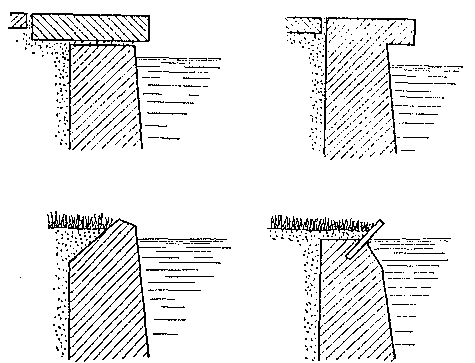 Different types of the upper surfaces of the walls of garden tanks.